We have all seen examples of distracted drivers – reading the newspaper while driving, putting on makeup or talking on a cell phone. Carnegie Mellon University scientists, as reported in the journal “Brain Research” by Dr. Marcel Just and colleagues, have concluded that we cannot converse on cell phones without distracting our brains from the task of driving. Scientists determined that the amount of brain activity allocated to visual processing tasks decreases by nearly 30 percent when a person is listening on a cell phone. Other research suggests that driving while talking on a phone reduces situational awareness equivalent to driving while impaired.
There is no denying that using a cell phone while driving diverts our attention, yet this is just one of many activities that can distract a driver. Managing distractions becomes even more of a critical safety issue when a driver is in control of a 40,000-pound bus with up to 40 passengers. Metro Transit in Minnesota is committed to interacting safely with other drivers while providing our customers with a safe ride and that is why we developed a program to help our operators stay focused on driving and to help control all their distractions.
Producing a Video
In 2004, the problem of distracted driving was forced into the spotlight for Metro Transit. While investigating a bus collision with a cyclist, we learned that the bus operator was using a cell phone. Although our concern was growing in regard to cell phone use, this incident prompted us to study all policies and procedures related to distracted driving. Consequently, our innovative approach was to use education and measured enforcement to reduce accidents caused by all types of distracted driving.
The Safety Department’s education efforts started by researching what resources were available on distracted driving. We found several options related to defensive driving, but distracted driving was a relatively new issue and we found only one training video focused exclusively on this topic. Ultimately, we used an existing video that focused on distracted drivers and then modified it with additional footage and dialogue to make it relevant and specific to Metro Transit bus operators.
In order to leverage our limited resources, Metro Transit collaborated with Aurora Pictures in Minneapolis to modify an existing training video on distracted driving. We spent $13,000 on all production costs, saving us between $25,000 and $30,000 on costs to produce a new video. The video produced was professional and dramatic.
On a larger scale, the effort represents a new focus for training within a transit agency. Distracted driving is not just about using cell phones; it includes a wide range of issues. We incorporated the science from Carnegie Mellon and changed our procedures for radio use on buses, which is described in the video.
Although the video was specific for Metro Transit equipment and operations, we provided advice to the producers on how to make a generic public transit version. In the generic transit version Aurora Pictures produced, the same issues are discussed and viewers are encouraged to refer to their own company policy. Any agency could purchase this video or modify it to meet its own goals. If another transit agency combined this video with enforcement and other education strategies, the agency could see the same success we did.
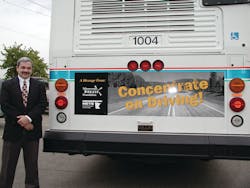
The video was shown to all operators during our 2005 Right to Know annual training. We supported the initial roll out of the video with flyers and posters. In addition, we partnered with Minnesota Safety Council to provide public outreach ads on the backs of buses (see photo at right). We also asked operators to sign a pledge that they would not drive distracted. The video is now part of new operator training.
Process in Action
In terms of enforcement, we took a measured approach. Metro Transit clearly communicated to our operators its interest in eliminating the hazard created by distracted driving. In November of 2004, the definition of an electronic violation was changed to include talking on a cell phone or radio handset, listening to an electronic device, or wearing an earplug or headpiece while their vehicle is moving. Moreover, the violation was elevated from a Class B to a Class A (or more severe) violation. Consequently, operators are subject to a Class A violation and a Record of Warning. That change reflected a more severe disciplinary action than ever before. To put this in context, if an operator receives three Class A violations over a 12-month period, discipline could include termination.
An important component of operator behavior comes to us from our customers. Metro Transit pays close attention to customer service complaints; they are logged and documented. Operators are counseled as appropriate and, based on the nature and number of complaints, an operator could be subject to disciplinary action.
Effectiveness
Metro Transit has data to document the effectiveness of its distracted driving initiative.
As noted above, Metro Transit pays attention to customer service complaints. Beginning in 2005, training on distracted driving was provided to all current bus operators and an emphasis on enforcement followed the training. When education was supported by measured enforcement, we saw the largest decrease in customer complaints in 2006.
We have also learned that we cannot simply engage in a solitary campaign and be done with it. We noticed that about two years after our concentrated effort the complaints had increased a bit. We are currently working through ways to re-emphasize the program. In 2008, Metro Transit changed the Safety Awards program so that a Safety Class A violation (which includes electronic device violations) is treated just like a responsible accident. This precludes an operator from earning a safe driving award for that year.
Fewer Accidents Means Dollars Saved
Metro Transit tracks accidents and generates a rate expressed as accidents per 100,000 miles. Accidents for our purposes include collisions and on-board passenger falls, regardless of fault. If we pay attention to all accidents – not just at-fault accidents – we can work at avoiding all collisions.
Further, each accident has a value that represents the liability or cost to the company. Avoiding accidents, then, would translate to a company’s bottom line. It is often difficult to quantify the effectiveness of a program, but in this case we were able to calculate dollars saved through accident avoidance.
Except for a very slight increase between the years 2006 and 2007 (possibly explainable at least in part by the December snowstorms in 2007), both the nominal accidents and the accident rate has dropped. As a matter of significance, the accident rate has dropped to a point lower than we have enjoyed in 10 years.
Our Risk Management department has done a lot of work quantifying accident occurrences with claims expense. Every accident avoided equates to approximately $3,300 in reduced claims expense. Compared against the 2005 baseline, Metro Transit experienced 138 fewer accidents in 2008. If one uses the statistic from Carnegie Mellon, that between 25 percent and 50 percent of all accidents are attributable to distracted driving and assuming that our operators are half of the equation (the other half being the other driver, etc.), then the claims savings for Metro Transit’s distracted driving mitigation program would be somewhere between $57,000 and $227,000. Further, when one applies property damage costs, administrative costs, workers compensation, etc., the savings are even more dramatic.
Metro Transit has a fiduciary duty to the citizens of Minnesota and an ethical responsibility to preserve the safety of our employees, our patrons and the public at large. We have demonstrated that our distracted driving program contributes to fulfilling our stewardship responsibilities, enhances safety and actually translates to cost savings.
Michael J. Conlon is director of rail and bus safety with Metro Transit and Brenda L. Himrich is manager of bus safety with Metro Transit.