Never are colored lines and circles more important to so many people than on our nation’s most traveled urban tracks. The maps and schematics that depict the world of subways and metro rail define them — in part.
To understand the culture of a transit system and the city as a whole, you need look no further than the maps. Urban rail maps come in two basic flavors: geographical maps and schematics (also known as diagrams). But this flavor comes swirled too. A geographical map is much more than train routes — it is also the bends of the lines and the landmarks in the city. Most designers go a different route with the schematic approach, a geometric design of routes laid over a generic sketch of the city's most well-known features.
The pros and cons of geographic versus schematic are clear. In a geographic map, the stations are put into a proper context with the city and its landscape. The distance between the stations, the actual directions and the cross streets all have their rightful place, helping the traveler easily correlate life on the rails to life on the streets. But it can also become tricky to deal with large spaces, tight turns and areas with a high concentration of stops versus areas with greatly spread out stops.
The schematic takes that out of the equation by not binding the designer to the rules of distance. Schematics become a rough sketch of distance and space, more a guideline for directions. This can lead to some misguided conclusions about where stops are in relation to outside attractions and leave people wondering just how far apart stations are from each other.
The debate rages on, with every map and schematic designer trying to take bits of what they like from each school of thought and create their own hybrid … if they can.
Whether map (New York) or schematic (basically everyone else), one thing is certain: Each city defines their character differently, holding different aspects of their transit map/diagram/schematic in esteem. For New York, it is the ability to display a massive amount of information in a geographic model. San Franscisco’s BART system schematic puts you in constant relation to the water. Washington, D.C.’s, Metro schematic — which has stood the test of time better than any American transit diagram could dream of doing — lets you in on a little history along the way. Boston’s design links rail to buses. And Chicago's approach puts details in the downtown.
New York
John Tauranac is part legend and part pot-stirrer. While Tauranac isn’t a map designer by trade, he fell into helping create New York’s 1979 geographical map through “more serendipity than anything.”
His devoted passion to mapping the underground passageways of New York in the 1970s coupled with his love of history. While working with a graphic designer, Tauranac started mapping New York’s underground for New York Magazine. The New York Metropolitan Transit Authority (MTA) called on him to guide a cultural bus loop. Soon Tauranac was talking with MTA officials about putting points of interest on the subway map.
The then-used Massimo Vignelli schematic design riled Tauranac. “I rejected the idea of including the schematic map (with landmarks) because I hated it,” he says with no hesitation from his office in New York. “It meant distorting the geography to the Nth degree.”
Tauranac teamed with map designer Michael Hertz and they created a map for a 1976 travel guide. Soon a new MTA commission was formed to design an entirely new subway map. Tauranac successfully led the charge to go both with a color-coded system and change to a geographic approach. “Some thought schematic was modern and others thought geographic puts the subway in perspective within the city it serves,” Tauranac says.
Tauranac and Hertz gave New York something it is still the only major urban rail line in the United States to have: a geographic transit map. “I tried to put things in perspective,” Tauranac says. “That’s the point. Take people by the hand and guide them through the system. I am by nature a tour guide, so when you combine those elements with someone who likes to design maps, you have a fairly good combination.”
Because New York’s subway is about moving so many different types of people — locals, tourists and everyone in between — the thought of landmarks is crucial and helped lead the 1979 version, even though clarity becomes a hot commodity.
“It is a very delicate balance,” he says. “There are certain landmarks that literally mark the land. The Empire State Building is visible from so many different neighborhoods. I think places like that are important, however, how do you depict it on a map? Do you just put a circle and say the Empire State Building is here? A schematic map is purely a transit map. You play god when you make a map. There is a degree of truth to it, so on the geographic map I did put in every hospital, college, university or major cultural institution.”
Of course, even a diehard geographic map-lover such as Tauranac sees the style and allure of the schematic design, which is why he released his own hybrid version of the two in 2009. While not the official version, such as the one still in use — despite some tweaking — from 1979, he is trying to weigh the good and the bad of each design, but still leave New York's tourist-friendly map intact during the process.
Vignelli says that most major cities have diagrams and those are “by far” superior designs. “It is the proper way to do it,” he says from his New York office. “You have to be a moron to do anything else. A subway map is a subway map. To try to put five pounds into a one-pound bag … it doesn’t hold it, which is exactly what happened in New York. Maybe it works, but it is certainly ugly.”
Vignelli adds that conveying how to go from station A to station B is the point of a transit diagram. Any necessary tourist information will appear on different maps.
And that is where Vignelli and Tauranac have chosen to disagree for so long. Tauranac wants to give direction beyond the subway. “I’m empathetic to tourists, to visitors, to the sometime user of the subway,” he says. “Northing is worse than thinking you are on the wrong train in the wrong direction. It is an awful sensation.”
So landmarks it is. In New York.
Washington, D.C.
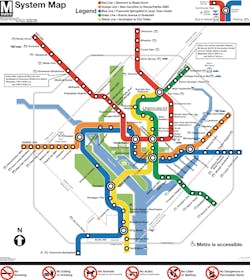
Lance Wyman is proud of his work. He should be. The diagram he did for the D.C. Metro in 1976 is still in use today.
The New York-style debate of diagram versus geographic map wasn’t even an issue in Washington, D.C. With Vignelli part of the master planning, the diagram choice was the first and only option. What did get a lot of debate — but didn’t go through — was to give each line its own historic icon. Wyman says that had they pulled it off, the D.C. map would have been even more unique than it already is.
But he was able to move his icons into the off-track portion of the diagram, using them to depict major landmarks within the Mall, giving “a sense of orientation for the city around the Mall.” It has a geographic feel, but still within the geometric style of a schematic diagram.
“That was one of the biggest struggles,” Wyman says about trying to depict the historical markers within the city while still balancing out the parts of the Metro that are outside the city. “It wasn’t easy keeping it balanced. I had to work very carefully to keep it diagrammatic. The bottom line is to keep it as clear as possible where stations are relative to each other on the lines.”
Wyman says he had to push for a bit of balance away from just a pure diagram, such as the one Vignelli was pushing for, because it was simply too “confusing” with a lack of information. “You have to give a sense of information without losing (the station depictions).”
Wyman kept a natural relationship with the outside world, using light blue for water and light green for parks, which allowed the white icons to work themselves into the diagram. Then he played with geometry, keeping the lines on 45-degree angles where possible.
The lines' color-coding system helped keep the diagram clean and he developed larger circles to mark interchange stations, another clean move full of information.
His clean, informative hybrid creation is still in use today. “It is a very nice feeling,” Wyman admits. “In doing this type of work where you are putting it out in the environment where it is used on a daily basis, this is the very best reward.”
Boston
Frustration played a major factor in Ken Dumas turning a fully schematic design for Boston's Massachusetts Bay Transit Authority (MBTA) rapid transit map into something a little more informative.
New in 2010, the Dumas map has gently added in “key bus routes.”
“We wanted to give a hypothetical,” he says. “If you are in the D branch of the Green Line and you wanted to go to Harvard Square on the Red Line, people don’t know they can get off and take the 66 bus in half the time,” Dumas said.
The culture of Boston as an old European-like city, with major congestion in the downtown core, made promoting the bus routes even more important. With the Charles River a major divide of the city, the new map helps people find bus-route shortcuts. “The essence of the current version of the map is about promoting transfers,” Dumas says.
This mapping system is unique to Boston, a multi-mogul system that isn’t so featured on the vehicle, but more on the ability to get to the right location quickly. But the look of the map still puts a hierarchy on rapid transit, with the boldest lines being rapid transit, then commuter rail, and then key bus routes. “If the lines are too thick, it becomes overwhelming,” he notes.
The biggest challenge in providing even more information was trying to mesh bus routes into the rigid 45-degree angle look of the geometric diagram. The map Dumas worked with was fully schematic in that it didn’t distinguish distances between stations. “I started with a map roughly geographic with an angular design, just with softer rounder edges when (lines) change directions,” Dumas says. “When I was laying the bus routes down in the process of keeping the rigid structure, I had to fudge subway stations and move them around to make them line up. The challenge was to not drastically alter the prior design, but essentially meld the two together.”
Being from the suburbs and always frustrated that the old schematic map didn’t show how far apart stations were in the outskirts, or even the correct directions of the lines, that was the catalyst to bringing a touch of geographic reality back to Boston. “The old green line was shown going south when it really goes west,” he says. “It confused me as a child trying to figure it out. If a particular line is farther out, show it. Show it as longer and don’t be afraid to not have lines go all the way to the edge if they don’t need to.”
And going even more hybrid geographically, Dumas made sure that Boston had some of its coastal character displayed on the map by adding in the Charles River and the shorelines, two aspects that weren't there previously. “Can’t we show the Charles River?” Dumas asks. “We should be showing the shoreline.”
The geographic line must be drawn somewhere. He didn't want other landmarks cluttering the information-heavy design, although a few major freeways made it in to help orient people to park-and-ride stations. He also wanted to follow the London version of being “easy on the eye” instead of New York with all its bending and curving.
Boston's tourist industry and major influx of students puts simplicity at a premium. “Because we have such a crazy city and don’t have streets laid out in a geometric pattern, to lay on top of a street grid wouldn’t make sense," Dumas says. "If I could get a tourist to understand (the map), I can get anybody to understand it. Tourists would have other maps that show other things and the MBTA subway map should look a little like other maps they have seen so it is not a stretch.”
Chicago
There is a look to Chicago. And Dennis McClendon wanted the Chicago Transit Authority's (CTA) Rail "L" System Map to have that look. He tried playing around with London-looking ideas, but Chicago needed something of its own, all while depicting Lake Michigan to the east.
In the end, what he created in the late 1990s—but is just now starting to be phased out—had white dots enclosed within thick colored lines, the dumbbell system to call out transfer points and a schematic approach.
While Chicago has wavered for years on what style they want their map to be, as they are now starting to shift back to a geographic look within the stations but have kept the schematic look with an added street grids elsewhere, McClendon says that the schematic style makes the train system clearer. Much clearer.
With such a tightly knit grouping of stations in downtown make the need for schematic even greater and a pull-out box depicts the heart of downtown. “It goes back to Harry Beck’s London map that says people in the system need to see how to get to other points in the system and how that relates to the geography outside is less important than understanding the transfer points within their rail system,” McClendon says. “That is an arguable point in a city like Chicago where the rail and bus systems have been so tightly integrated.”
That is why the downtown inset can be so important, because it “doesn’t do any huge violence to the geography of the city.”
To help understand the geography, most stations are already named for cross streets. McClendon says that putting Lake Michigan in becomes “sufficient” for Chicago geography since everything in the city is oriented to the lake.
After all, the map is mainly about the stations. McClendon says that is how it should be.
San Francisco
End users designed the simplistic Bay Area Rapid Transit (BART) system map in San Francisco, says Linton Johnson, BART chief communications officer. The map isn’t for cartographers and designers, it is for customer route planning.
The BART map has morphed over the years, from the first schematic produced in the 1970s to a geographic look in the 1990s. The system has come full circle to a schematic look with the effort of navigating the BART system the only focus. “Removing a lot of the additional geographical information that was displayed on the original map was the best way to do this,” Johnson says.
Although the diminishing of geographic elements included a slight reduction in water — although a first-time viewer of the map sees plenty of water — it still plays a major factor in the way the Bay Area navigates its transit system.
The subdued, simplistic style is also easily reproduced on multiple platforms (web, small brochures and large-scale station posters) and in multiple lighting conditions.
Individual transit maps are based on the culture of the city and the transit maps then help define culture. The designs that mesh culture with function prove to be the most effective diagram. It isn't all about colored lines and pretty dots, but it does have to start somewhere.