Strategically Prioritizing Your Capital Needs
Few industries are likely to see as great a near-term opportunity to transform themselves as mass transit. The country’s focus on economic development, mobility and the environment all point to an increasing role for mass transit. This emphasis on transit was seen in the American Recovery and Reinvestment Act of 2009 (ARRA) which provided $8.4 billion for transit capital projects.
The question is, how can transit seize the opportunity for a larger role in the U.S. transportation sector? Are transit organizations prepared to clearly demonstrate that investing in transit will produce outcomes the country wants? Are they changing processes quickly and thinking differently about capital programming?
Yes — and no. With the U.S. economy in a tailspin, and the financial sector on life support, the federal government stepped in with ARRA to spur growth and put the nation’s economy back on track. As a result of ARRA, most transit agencies went through the process of evaluating their current capital needs, identifying what was “shovel ready” and selecting projects that would promote economic growth. However, proving the value of transit investment will take more than one infusion of funding. To solidify transit’s growing role, transit agencies will need to clearly connect decisions to strategic outcomes and performance measures.
One agency, the Washington Metropolitan Transit Authority (Metro), took lessons learned in the selection of its ARRA projects and applied this approach to its overall capital needs program.
Identifying Capital Needs
Metro is the second largest rail transit system, the sixth largest bus network, and the eighth largest paratransit service provider in the United States. Created by an interstate compact in 1967, Metro is tasked with planning, developing, building, financing and operating a balanced regional transportation system in the national capital area.
Similar to other transit agencies, Metro regularly conducts a comprehensive assessment of its future capital needs. In September 2008, Metro staff presented to its board of directors the capital needs inventory (CNI) which outlined more than $11 billion in needs over the FY 2011 to FY 2020 timeframe. The CNI includes performance projects ($7.6 billion, 67 percent of total) and customer/demand projects ($3.8 billion, 33 percent of total). Performance projects maintain and replace assets on a life cycle basis. They promote safety and reliability and preserve the current levels of service. These projects keep Metro in a "State of Good Performance" — assets are not simply replaced with an exact replica, but with assets that take advantage of the latest technology and materials for greater efficiency.
Between 2010 and 2020, average daily Metrorail ridership is expected to grow by about 20 percent. Over the same period, average daily Metrobus ridership is projected to grow by about 15 percent. Of all its modal services, Metro’s paratransit service, MetroAccess, is expected to experience Metro’s fastest growing ridership at 114 percent. Customer/demand projects help meet growing ridership requirements and improve the rider's experience. Safety needs are included throughout the CNI.
Together, performance and customer/demand capital needs address Metro’s physical assets, including vehicles, fleet maintenance facilities, operating systems, information technology and rail system track, among others. Not included in the CNI are system expansion projects (new entrances, stations or rail lines), transit projects entirely funded by state and local jurisdictions, debt repayment costs, project administration and other needs to be identified in the future by federal oversight agencies.
The CNI established Metro’s capital needs baseline. As Metro’s general manager states, “Our house is more than 32 years old. We have a wet basement, rusting pipes, old wiring and a 1976-model car in a 100-year-old garage. And the family is growing. Now we need to prioritize what gets fixed first.” That is exactly what Metro did.
Prioritizing of ARRA Projects
To ensure ARRA funding would fulfill legislative requirements and support the agency’s longer term goals, Metro conducted a new agency-wide prioritization process. In this process, Metro staff first identified which CNI projects were “shovel ready,” eligible for federal funding, could be completed in the required timeframe and could not be implemented without additional funds. The pool of potential ARRA projects totaled $530 million. The next question was, “how can we prioritize ARRA projects based on different funding constraints?” The answer was grounded in Metro’s strategic goals.
In August 2007, Metro’s general manager and Executive Leadership Team (ELT) established five strategic goals: (1) create a safer organization, (2) deliver quality service, (3) use every resource wisely, (4) retain and attract the best and the brightest and (5) maintain and enhance Metro's image. These strategic goals were designed to guide decision-making at Metro. To further refine these goals, Metro developed strategic objectives for each goal by conducting a series of internal discussions and reaching out to external partners as well, such as the agency’s Jurisdictional Coordinating Committee comprised of transportation officials across the cities and counties it served, the Riders Advisory Council representing everyday passengers, and the Accessibility Advisory Council representing riders with disabilities. Metro asked each of these stakeholders to define the strategic goals from their perspective.
Internally, the Capital Planning and Advisory Committee — Technical (CPAC-T), further refined the strategic objectives in a facilitated brainstorming session. The CPAC-T consists of members across the entire organization including the three modes (bus, rail, paratransit), Information Technology, Metro’s Transit Police Department and other capital intensive areas (e.g., elevators and escalators). This group of subject matter experts was developed to identify capital needs, evaluate capital needs and guide capital programming. To finalize the strategic framework, the ELT edited and approved the objectives listed in Figure 1.
[Figure 1] Metro Tree Diagram
Next, Metro needed to find a tool to conduct the prioritization process. In January 2009, Metro selected Decision Lens, a provider of decision support software solutions for government and commercial clients. The Decision Lens tool quickly synthesizes qualitative and quantitative information from multiple stakeholders to gain buy-in for trade-off or allocation decisions. Through its process, Decision Lens establishes accurate relative priorities representing a group’s business objectives, performance measures and alternative options so that organizations can focus on the highest value activities. Decision Lens was a distinctive tool because it ties together weighted criteria, voting, prioritization and resource allocation in a single collaborative product. The software also produces graphical representations of the prioritization process making it easy to communicate the results with staff and management.
Using Decision Lens, the ELT went through a “Pairwise Comparison” to weigh Metro’s goals and objectives. In this process, executives compared Metro’s five strategic goals and related objectives through a set of judgments in which two elements are compared at a time using remotely controlled voting keypads. This “Pairwise Comparison” process derives criteria weights collaboratively, rather than by assigning arbitrary weights by an individual. The process also provided a key opportunity to explain, defend and rationalize where the organization should focus.
At the same time, the CPAC-T met for three half-day sessions to vote on how significantly each potential ARRA project contributed to each strategic objective (critical, very important, important, marginal or no contribution). CPAC-T members would advocate and vote on behalf of its needs, in addition to being able to hear and vote on needs across other departments. This approach formed the basis of a repeatable, collaborative and transparent decision-making process. A key strength of the process was the wide-ranging experience of the CPAC-T
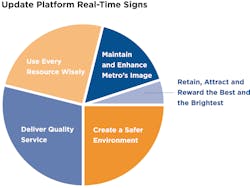
As a result of the CPAC-T voting sessions, each ARRA project received a score that indicated how strongly it is linked to Metro’s goals. The project score is calculated by the Decision Lens software by multiplying votes (from CPAC-T) with weights (from ELT). In other words, the project score indicates its role in achieving Metro’s strategic goals and objectives. For example, the pie chart below illustrates how ARRA project, Update Platform Real-Time Signs, contributes to Metro’s strategic goals.
[Figure 2] Metro Pie 2
The final step in the prioritization process was the selection of ARRA projects under different funding scenarios. The Decision Lens tool optimizes based on high value and relative low costs to ensure a portfolio yields a maximum strategic benefit. The tool’s sophistication also enabled Metro to address project interdependencies (e.g., if additional rail cars are purchased, new maintenance facilities will also be required), fund projects with contractual obligations and reflect management overrides related to projects that were too critical to leave unfunded. Approximately 70% of the final funding decisions was directly based on the prioritization results.
In summary, the prioritization process established a transparent and collaborative approach to evaluating capital programs, building consensus and linking decisions to Metro’s strategic framework. The Decision Lens tool was crucial to providing a framework to facilitate the process that was easy to use. Metro was able to conduct “what-if” scenarios based on different funding levels, project constraints and management guidance. As a result, Metro became the first agency in its region to have an approved list of stimulus projects from its planning board.
Continuing Prioritization and the Future of Strategic Planning
Given the positive reviews by Metro managers regarding the cross-agency communication, collaboration and capacity-building generated by the ARRA project prioritization process, the agency pursued a similar effort to prioritize its more than $11 billion CNI. To systematically tackle this much larger scope, Metro applied lessons learned during the stimulus experience to make project-by-project examinations less time intensive.
In October 2009, Metro staff presented the CNI prioritization results to its board of directors highlighting which capital needs should be funded first and which would need to be deferred to beyond FY 2020. The Decision Lens tool enabled Metro staff to prioritize based on different funding constraints, project’s relative priority to other performance and customer/demand projects, project budget, asset age and policy considerations.
Using prioritization results, Metro staff could clearly communicate the impact of funding constraints to its board of directors. For example, if Metro's funding continued at recent levels (about $500 million per year), only 69 percent of Metro's performance needs would be met and zero funding would be available for customer/demand needs over the FY 2011 to FY 2020 timeframe. At historical funding levels, Metro would not be able to fully fund the investments needed to maintain the system's safety and reliability.
Metro was also able to highlight top priorities such as the rehabilitation of sections of the rail system that are more than 30 years old, replacement of older rail cars and buses, replacement/rehabilitation of three of Metro’s oldest bus garages and information technology system upgrades. Key customer/demand projects recommended as high priority include rail fleet expansion and power upgrades that would allow the full use of eight-car trains on all rail lines, safety and security enhancements, such as building a police training facility and expanding the Metrobus and MetroAccess fleet of vehicles.
The identification and prioritization of Metro’s capital needs were the first two phases of the strategic capital planning process being developed at Metro. As the figure below illustrates, the core of the strategic process is Metro’s agency goals which guide investment and implementation decision. Next, Metro staff will develop a six-year capital program (FY 2011 to FY 2016) based on the CNI prioritization results, committed project funding, preventive maintenance needs and other policy considerations. The first year of the capital program will represent Metro's FY 2011 capital budget. How prioritization results will guide capital reprogramming efforts remains unclear. Once the capital program is delivered, the final step is monitoring how efficiently the capital program was delivered and to evaluate progress made toward agency goals using performance measures. If strategic goals are being used to guide capital decisions, it will be vital to ask, “Did the investments make a difference?” All of the steps contained in this strategic planning process have existed at Metro, but the connection between these steps and agency goals is being strengthened.
[Figure 3] Metro’s Planning Process
Funding Priorities — Today, Tomorrow and Beyond
An increase in funding can often create opportunities for innovation. ARRA provided such an opportunity by enabling transit providers to demonstrate their role in the national economy and transportation system. Metro acted upon this opportunity and successfully connected ARRA project selection decisions to its strategic goals. The benefits of this approach were so clear that Metro continued this strategic prioritization for its longer term capital needs.
Prioritization of Metro’s capital needs enabled staff to link agency goals to capital investment decisions, establish a transparent and replicable process, address funding constraints and reinforce the foundation for capital programming. This new capital decision-making process has allowed Metro to evaluate crucial trade-offs using the wide-ranging experience of its staff, and to allocate the available financial resources to yield the greatest return to Metro customers.
Metro’s growing emphasis on strategic decision making can also be seen in the recent creation of the Office of Performance. The mission of this office is to increase the use of performance information to guide actions, to promote Metro’s benefits in the region and to unify employees to accomplish agency goals. Simply stated, this new office was established to inform, promote and unify Metro.
As the country focuses on the economy, mobility and the environment, making the case for transit investments is paramount. By linking funding decisions to strategic goals, using viable tools like Decision Lens and tracking progress, we can demonstrate the benefits of transit capital investments. Can any of us afford not to?
Patricia Hendren is a director in the Office of Performance at Washington Metropolitan Transit Authority.