I had a lot of people question my sanity when I told them I was heading to Cleveland for an upcoming cover story. The fact is that Cleveland could easily be transit’s best kept secret. I’ve been to cities touted for their transit systems and still had to spend hundreds of dollars for a taxi just to and from the airport.
What most of those naysayers don’t know is that Cleveland is brimming with transit options — bus, rail, subway, BRT RTV. That last one you may not recognize. Greater Cleveland Regional Transit Authority (GCRTA) CEO Joe Calabrese refuses to call the Euclid Avenue line by the more familiar bus rapid transit name, instead preferring Rapid Transit Vehicles.
“I do not call them buses,” Calabrese says. “Buses shouldn’t cost $900,000.”
It’s this no-nonsense approach that Calabrese brings to every part of his system. He prefers to be involved in most aspects, including leading the tour of a transit magazine editor personally. This approach fits his transit background perfectly.
Diving In
Emerging from graduate school in 1975, Calabrese faced an uncertain time with skyrocketing oil prices and a call for more public transit investment. Presented with opportunities with Mobil Oil or the Central New York Regional Transportation Authority (CNYRTA), he saw transit as the future, but he had no experience. So he dove into the deep end.
“I knew nothing about public transit,” Calabrese says.
“I said I would love to come and work for you and he wanted me to really head up his labor relations and the training department. But I said you know I really wanted to learn the industry first. So he gave me six months to learn the industry.”
So Calabrese began what is likely the first version of Undercover Boss.
“I got enrolled undercover through the bus driver training program for 30 days. I drove for 30 days. I then went into the maintenance department. I worked as a mechanic. As a servicer as a hostler. I worked in the parts room. I worked as a dispatcher. I worked on the radio. I worked as a station master and a number of things,” Calabrese says.
“And then I said OK, now I think I’m ready. Because when I sit down across from that 20-year bus driver and tell him or her how he or she could have done this better, not that, I’ve got that experience, but at least I want to have a better idea how it should be handled.”
Calabrese would work his way up through the ranks at the CNYRTA for the next 11 years, including being assistant general manager for eight years. Then an opportunity presented itself and he moved to the private sector with his own company.
“Myself and a friend had an idea to be entrepreneurs. We became entrepreneurs. We quit our jobs. We left. We started a company called Metrovision of North America. We installed, operated, serviced and maintained public information systems for some of the major transit systems around the country,” Calabrese says.
After several successful years the company was sold and transit pulled him back in, “My phone rings at 7 a.m. that morning and it’s my old [CNYRTA] boss saying I’m going to retire now are you ready. So I said yes. I went back as executive director/president there for six years.”
From there Calabrese moved to another RTA, this time the Greater Cleveland Transit Authority (GCRTA) looking for that next step.
“I think in Syracuse we had things under control,” Calabrese says.
“I wanted to make a career move. This was a multimodal city. And to go from a medium-sized system to a large system with light rail and heavy rail and a proposed New Starts project somewhere in the pipeline. I thought that would be challenging and be a good career move. And it was.”
Calabrese came to GCRTA under a three-year contract, but after a year in Cleveland he went to his board seeking more continuity.
“The staff needs to know that I am going to outlast some of them,” Calabrese says.
“Because a lot of it is they see this guy come and go and come and go. And we can outlast them. And that’s too prevalent in the industry.
“With the average general manager probably being, you know, at one point in time it was probably about 3.5 to 3.9 years.
“So they made it a five-year contract, after four years they made it a 10-year contract, after eight years they made it a 15 year contract.
“So I finished my 10 years on Monday and I’ve got five years to go. It has been a lot of fun.”
Economic Challenges
Calabrese admits there have been a lot of changes since he arrived at the turn of the century and that it’s been very challenging, especially from an economic perspective.
Like many other cities, Cleveland has been hit hard by the current recession. But in this blue collar town the transit situation seems a little bleaker than other areas.
“We were down about $5 million last year in passenger revenue based on our projections,” Calabrese says.
“We were down more money from the state’s perspective. The state cut our funding again. It now totals a 75 percent cut since 2002.
“And the sales tax. We’re projecting this year the sales tax to come back slightly. We’re projecting a 1.2 percent increase of the sales tax.”
Unlike other agencies who may have a “rainy day” fund to fall back on when their operating funds run low GCRTA is reliant on its current operational funding due to past challenges.
“I think we’ve never had that rainy day fund that we could draw on,” Calabrese says.
“The reason being when our average annual sales tax went from an average of 5.6 percent per year [in the 1990s] to -1.2 percent [in 2001] to 1 percent per year, we’ve already spent our rainy day fund between 2002 to 2008 to minimize the cuts we needed.”
Unfortunately, GCRTA may have been on the leading edge of the current operational funding crunch agencies across the nation are feeling. Calabrese admits that while the agency may be getting spread thin, it will endure.
“When this cut came as quickly as it did and as dramatically as it did, and the fact that we’ve already trimmed a lot of the less productive services … we’ve already done a lot of the things maybe other people are doing,” Calabrese says.
“The quantity of service, I don’t know how many people it’s going to affect. It may make it less convenient for a lot of people, but it won’t make RTA unavailable to a lot of people.
“That’s really the job that our service planning team is doing now, and I have great confidence that they are doing it well.”
One problem facing Cleveland is a declining core population. As Calabrese points out, the city itself is half the size it was in the 1970s with a population now a little less than 450,000 when it once boasted almost 1 million. This among other factors, including funding, has forced GCRTA to cut about 4 percent of service in April, a difficult choice for any agency.
“We just completed a series of 12 public hearings on service cuts. It was not a pleasant thing to sit through,” Calabrese says.
“It’s one of those things when you sit through that the one very positive thing that comes out of that is you realize how important what we do is to so many people.
“In many cases people that don’t use public transit, and maybe even people that only use a portion of the public transit system in their city have no idea how important we are to others.
“It’s like me saying to you, ‘Fred, effective April 4th I’m going to take your car away.’ Take my car away? You can’t take my car away. How am I going to get to work? It’s that same reaction.
“We were telling our customers we were going to take their car away. I mean tough stuff.”
Calabrese says that the overall goal has been to retain as many riders on the system as possible, “It’s easy to say here’s our worst performing routes, let’s just cut those 10, 12, or 15 routes, but really we looked at route by route and route segment by route segment.
“We tried to combine routes, consolidate routes — have this route going through these people here, and having this route servicing these people there. To really come up with the best new RTA we can to alienate the least number of people with this new service plan.
“We’re really hoping that there is going to be very few people who can no longer use RTA, but there are going to be some people who have to transfer. Have to go from a bus to a bus or from a bus to a train or a bus to a train to a bus to get where they are going.
“But it was important that they could still get to work and support themselves.”
Back to Basics
Coming into a transit agency for the first time any new general manager is going to want to take care of issues they feel have been plaguing it and generally put their stamp on the system. When Joe Calabrese came to GCRTA he was faced with four major planned projects and found that they weren’t actually the issue at hand.
“I went to a public hearing about extending the red line beyond the airport,” Calabrese says.
“A customer was there at the public meeting and she said I live in Berea, which is south of the airport. I take the bus from Berea to the train station.
“The buses sent to pick me up in Berea were all 18- and 19-year-old buses. And three days last week the buses broke down before they got to the train station. Shouldn’t you worry about those things first?”
Calabrese says this was the impetus for his “Back to the Basics” plan for RTA, which he says breaks down to some simple must haves: a good quality product, customer service, image and financial health.
“I had to sit down with the board a few months later and say we’ve got these four major projects, but you know there’s no way we’re going to get federal funding to do them. No way we can financially operate them. We’ve got to pick our best of the four and really get back to the basics,” Calabrese says.
“And to a board member they all [had a] big sigh of relief, because we’ve got to focus on our core mission. And at that point we replaced almost our entire fleet in a 3- to 4-year period. We had one of the youngest fleets in the nation because we had one of the oldest fleets in the nation.
“So my philosophy has always been you should give a bus a Christmas party at its 12th anniversary and then give it a retirement party that same day because it costs half as much to maintain a six-year-old bus as a 12-year-old bus.”
Calabrese says that though the federal regulations stipulate keeping buses for 12 years, he says you shouldn’t keep them much longer than that. And RTA hasn’t. Currently its average fleet age is 6.5 years.
“We can’t buy any more buses because we wouldn’t have anything to replace,” Calabrese says.
Rapid Transit Vehicles
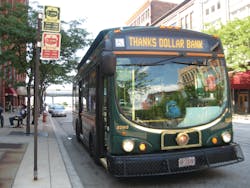
As I mentioned above, Joe Calabrese doesn’t like to refer to the line running on Cleveland’s Euclid Avenue as a bus rapid transit line. He prefers “rapid transit vehicle” and this line is arguably as close as you can get to rail without steel wheels.
Ohio’s first New Starts project, “Health Line” was designed, developed and built like a rail system harkening back to when streetcars ran along Euclid Avenue. The buses were designed with doors on both sides and even have the same horn as a light rail vehicle — not just the same look, the same sound, too.
“We had to design the vehicles, which was a multifaceted process,” Calabrese says.
“In the end we worked with New Flyer to develop them. We actually paid them about $1.9 million to design the vehicles.
“No manufacturer wanted to build what Joe wanted. They wanted to build what they build. We said, well if you build this there may be a market for it. And they said well, if we build this there may not be a market for it. So we said hey this is what we want. We will pay you to do the design development testing to take it down to Altoona, but if in fact there is a market for this over and above what Joe wants we want our money back.
“So basically we did a royalty agreement with them. We got all of our money back. These vehicles now have been sold I think in 14 or 16 different cities. I think it worked out very well for the industry, not just us.”
And if you ask Calabrese how the project has fared, he is honest, “At this time they’re positive. During construction it was difficult.
“[Business owners] were very supportive because they could see the future of Euclid Avenue.”
Completed on time and on budget, the Euclid Avenue project presented the problems most agencies see with New Starts, which Calabrese says is all about keeping your focus.
“New Starts projects are difficult. You’ve seen a number of people who’ve gone through that,” Calabrese says.
“I think it’s just staying positive, being out there with the public and not hiding in your office. I think one of the big differences we do today that I think a lot of other systems don’t or maybe other general managers don’t is really the fact of being out with the community.
“Being on local boards. Being on local committees. Getting to know your people. Continually telling the story. Working on the image of the agency. Working on how important the agency is to the integral overall economic development growth of the city.
“And it’s ignoring some of the bad stuff. Keep pushing the positive stuff. Don’t dwell on the bad stuff or it will drive you crazy.”
Youth Movement
Joe Calabrese understands the value of experience. Coming into the transit industry he had no idea how it worked, but he underwent a comprehensive self-developed training program, which gave him insight into the various facets of transit. Now he’s giving back through a program bringing in college graduates to transit and throwing them into the same deep end he dove in years ago.
“It’s difficult to hire people you don’t need, especially in tight economic times,” Calabrese says.
“But we’ve got a management development program. A couple years ago we were able to go out and hire five of the greatest, smartest, young kids out of college that you’ve ever met and said to them do you want to learn an industry.
“We put them through literally a two-year training regiment [where they] work in HR, work in legal, work in operations and work in maintenance. They just graduated a month ago and now they’ve assumed permanent positions.”
Calabrese says that the results were so positive that they are continuing the program with four more candidates for another two-year program.
“It does a couple things. It teaches them the industry, and it also teaches them the people they are going to be working with. You need to know if there is a problem or if you need information who to call — who does what where. Among many transit systems, especially among the large ones, they’re so decentralized. There’s 10 different buildings, you can work someplace 30 years and never meet people.
“These people are in every building and end up being very productive. Not just training but very productive.”
I asked Calabrese if he was concerned about the candidates undergoing the training and then jumping ship to another transit agency and his response was candid,
“Of course. But the alternative is not doing it.
“I tell you I am a little surprised and also very delighted that they went through their two years and didn’t leave.
“And we don’t do this at the detriment of current employees. Current employees could have also applied to be part of this program and one did. One of the five is a current employee.”
Calabrese says it’s all about putting together a good staff. His staff he would match against any other, “I have a very good staff. I’ve been blessed with a very good staff. Very stable.
“We’ve really tried to focus on hiring better people. You can’t have a great system without great people.
“And I think a lot of transit systems don’t put enough emphasis on the caliber of the people coming in.
“[Transit] should not be a job of last resort. These are wonderful blue collar jobs. Someone with a high school education can come here and make $40,000, $50,000, $60,000 a year with great benefits.
“We can demand the best. And driving the bus isn’t the only thing. They really have to be good with the public — the whole public service thing.
“So we raised our criteria. We used to have an 8th grade educational requirement here. We made that high school.
“Little things like that sometimes are a hassle. Why do we need the high school diploma? Because I think you learn some things between eighth grade and high school. But one thing you do learn is to get your tail out of bed, go to school and accomplish something. So there may be a correlation between education and attendance.”
Relationship Building
When I asked GCRTA’s Joe Calabrese what advice he could give other transit managers, he gave me a list:
- Quality is number one.
- Determine what your region needs.
- Talk with customers and employees.
- Minimize your time in the office.
- Don’t be afraid to change direction — go with your “gut” instincts.
- Keep everyone informed.
- Be one with your community.
- Understand that we do very important work.
- Never stop selling public transit.
“You got a mission. You keep your head down and keep the legs driving. But obviously develop some allies in the meantime,” Calabrese says.
“Really working with elected officials. Making sure they are supportive. Finding out what they need to support the system, support you and support the agency.
“It’s really building those relationships like everything else in life. We were able to do that."